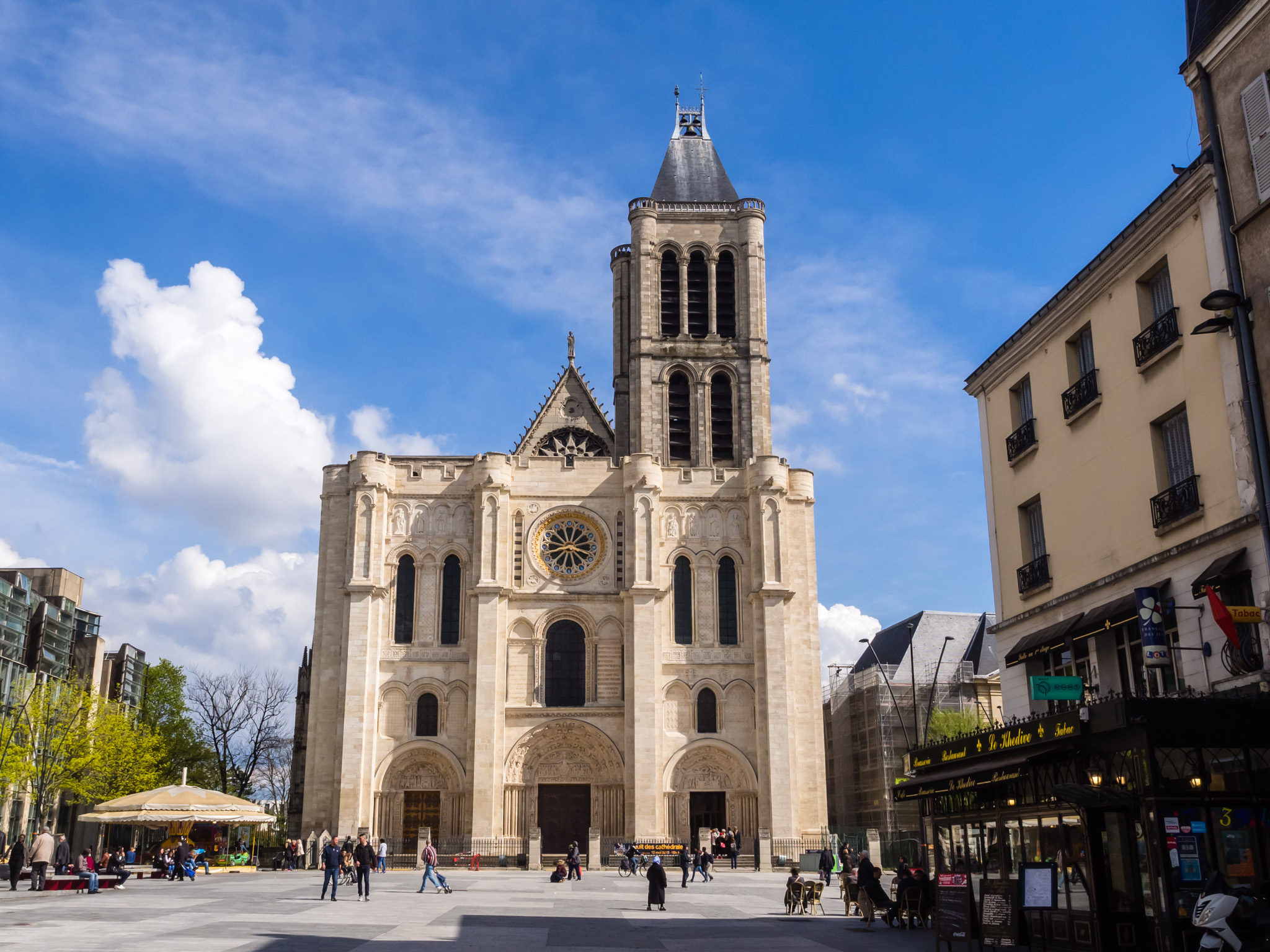
West Facade
The location of the Cathedral Basilica of St. Denis was determined by the eponymous saint when he deposited his own head after being decapitated in 250 C.E. by persecuting Romans. It is believed that In the late 5th century, St. Geneviève was responsible for the construction of the first church on this site. It was rebuilt in the 8th century in the style of a Roman basilica. In the 12th century, Abbot Suger built on the site what is considered the first Gothic church, employing construction techniques that illuminate the apse. What is considered to be the original burial ground remained at the center of all phases of basilica. It is still visible today.

Left West Portal
The location of the Cathedral Basilica of St. Denis was determined by the eponymous saint when he deposited his own head after being decapitated in 250 C.E. by persecuting Romans. It is believed that In the late 5th century, St. Geneviève was responsible for the construction of the first church on this site. It was rebuilt in the 8th century in the style of a Roman basilica. In the 12th century, Abbot Suger built on the site what is considered the first Gothic church, employing construction techniques that illuminate the apse. What is considered to be the original burial ground remained at the center of all phases of basilica. It is still visible today.
St. Denis is also notable for being a necropolis to the French kings and notables, with 42 kings, 32, and 63 princes interred in the cathedral. The tombs are marked by monuments and effigies. Remains of French and Frankish rulers date from as early as the 7th century.

Center West Portal
The location of the Cathedral Basilica of St. Denis was determined by the eponymous saint when he deposited his own head after being decapitated in 250 C.E. by persecuting Romans. It is believed that In the late 5th century, St. Geneviève was responsible for the construction of the first church on this site. It was rebuilt in the 8th century in the style of a Roman basilica. In the 12th century, Abbot Suger built on the site what is considered the first Gothic church, employing construction techniques that illuminate the apse. What is considered to be the original burial ground remained at the center of all phases of basilica. It is still visible today.
St. Denis is also notable for being a necropolis to the French kings and notables, with 42 kings, 32, and 63 princes interred in the cathedral. The tombs are marked by monuments and effigies. Remains of French and Frankish rulers date from as early as the 7th century.

Right West Portal
The location of the Cathedral Basilica of St. Denis was determined by the eponymous saint when he deposited his own head after being decapitated in 250 C.E. by persecuting Romans. It is believed that In the late 5th century, St. Geneviève was responsible for the construction of the first church on this site. It was rebuilt in the 8th century in the style of a Roman basilica. In the 12th century, Abbot Suger built on the site what is considered the first Gothic church, employing construction techniques that illuminate the apse. What is considered to be the original burial ground remained at the center of all phases of basilica. It is still visible today.
St. Denis is also notable for being a necropolis to the French kings and notables, with 42 kings, 32, and 63 princes interred in the cathedral. The tombs are marked by monuments and effigies. Remains of French and Frankish rulers date from as early as the 7th century.

Left Door Jambs of the West (Right) Portal
The location of the Cathedral Basilica of St. Denis was determined by the eponymous saint when he deposited his own head after being decapitated in 250 C.E. by persecuting Romans. It is believed that In the late 5th century, St. Geneviève was responsible for the construction of the first church on this site. It was rebuilt in the 8th century in the style of a Roman basilica. In the 12th century, Abbot Suger built on the site what is considered the first Gothic church, employing construction techniques that illuminate the apse. What is considered to be the original burial ground remained at the center of all phases of basilica. It is still visible today.
St. Denis is also notable for being a necropolis to the French kings and notables, with 42 kings, 32, and 63 princes interred in the cathedral. The tombs are marked by monuments and effigies. Remains of French and Frankish rulers date from as early as the 7th century.

Right Door Jambs of the West (Left) Portal
The location of the Cathedral Basilica of St. Denis was determined by the eponymous saint when he deposited his own head after being decapitated in 250 C.E. by persecuting Romans. It is believed that In the late 5th century, St. Geneviève was responsible for the construction of the first church on this site. It was rebuilt in the 8th century in the style of a Roman basilica. In the 12th century, Abbot Suger built on the site what is considered the first Gothic church, employing construction techniques that illuminate the apse. What is considered to be the original burial ground remained at the center of all phases of basilica. It is still visible today.
St. Denis is also notable for being a necropolis to the French kings and notables, with 42 kings, 32, and 63 princes interred in the cathedral. The tombs are marked by monuments and effigies. Remains of French and Frankish rulers date from as early as the 7th century.

Detail of the West Right Portal
The location of the Cathedral Basilica of St. Denis was determined by the eponymous saint when he deposited his own head after being decapitated in 250 C.E. by persecuting Romans. It is believed that In the late 5th century, St. Geneviève was responsible for the construction of the first church on this site. It was rebuilt in the 8th century in the style of a Roman basilica. In the 12th century, Abbot Suger built on the site what is considered the first Gothic church, employing construction techniques that illuminate the apse. What is considered to be the original burial ground remained at the center of all phases of basilica. It is still visible today.
St. Denis is also notable for being a necropolis to the French kings and notables, with 42 kings, 32, and 63 princes interred in the cathedral. The tombs are marked by monuments and effigies. Remains of French and Frankish rulers date from as early as the 7th century.

Detail of the West Right Portal
The location of the Cathedral Basilica of St. Denis was determined by the eponymous saint when he deposited his own head after being decapitated in 250 C.E. by persecuting Romans. It is believed that In the late 5th century, St. Geneviève was responsible for the construction of the first church on this site. It was rebuilt in the 8th century in the style of a Roman basilica. In the 12th century, Abbot Suger built on the site what is considered the first Gothic church, employing construction techniques that illuminate the apse. What is considered to be the original burial ground remained at the center of all phases of basilica. It is still visible today.
St. Denis is also notable for being a necropolis to the French kings and notables, with 42 kings, 32, and 63 princes interred in the cathedral. The tombs are marked by monuments and effigies. Remains of French and Frankish rulers date from as early as the 7th century.

Nave
The location of the Cathedral Basilica of St. Denis was determined by the eponymous saint when he deposited his own head after being decapitated in 250 C.E. by persecuting Romans. It is believed that In the late 5th century, St. Geneviève was responsible for the construction of the first church on this site. It was rebuilt in the 8th century in the style of a Roman basilica. In the 12th century, Abbot Suger built on the site what is considered the first Gothic church, employing construction techniques that illuminate the apse. What is considered to be the original burial ground remained at the center of all phases of basilica. It is still visible today.

Nave
The location of the Cathedral Basilica of St. Denis was determined by the eponymous saint when he deposited his own head after being decapitated in 250 C.E. by persecuting Romans. It is believed that In the late 5th century, St. Geneviève was responsible for the construction of the first church on this site. It was rebuilt in the 8th century in the style of a Roman basilica. In the 12th century, Abbot Suger built on the site what is considered the first Gothic church, employing construction techniques that illuminate the apse. What is considered to be the original burial ground remained at the center of all phases of basilica. It is still visible today.
St. Denis is also notable for being a necropolis to the French kings and notables, with 42 kings, 32, and 63 princes interred in the cathedral. The tombs are marked by monuments and effigies. Remains of French and Frankish rulers date from as early as the 7th century.

Trifrorium and Clerestory of the Nave
The location of the Cathedral Basilica of St. Denis was determined by the eponymous saint when he deposited his own head after being decapitated in 250 C.E. by persecuting Romans. It is believed that In the late 5th century, St. Geneviève was responsible for the construction of the first church on this site. It was rebuilt in the 8th century in the style of a Roman basilica. In the 12th century, Abbot Suger built on the site what is considered the first Gothic church, employing construction techniques that illuminate the apse. What is considered to be the original burial ground remained at the center of all phases of basilica. It is still visible today.

P4131752
The location of the Cathedral Basilica of St. Denis was determined by the eponymous saint when he deposited his own head after being decapitated in 250 C.E. by persecuting Romans. It is believed that In the late 5th century, St. Geneviève was responsible for the construction of the first church on this site. It was rebuilt in the 8th century in the style of a Roman basilica. In the 12th century, Abbot Suger built on the site what is considered the first Gothic church, employing construction techniques that illuminate the apse. What is considered to be the original burial ground remained at the center of all phases of basilica. It is still visible today.
St. Denis is also notable for being a necropolis to the French kings and notables, with 42 kings, 32, and 63 princes interred in the cathedral. The tombs are marked by monuments and effigies. Remains of French and Frankish rulers date from as early as the 7th century.

Main Altar
Basilica Cathedral of Saint Denis (Basilique Cathédrale de Saint-Denis)

Main Altar
The location of the Cathedral Basilica of St. Denis was determined by the eponymous saint when he deposited his own head after being decapitated in 250 C.E. by persecuting Romans. It is believed that In the late 5th century, St. Geneviève was responsible for the construction of the first church on this site. It was rebuilt in the 8th century in the style of a Roman basilica. In the 12th century, Abbot Suger built on the site what is considered the first Gothic church, employing construction techniques that illuminate the apse. What is considered to be the original burial ground remained at the center of all phases of basilica. It is still visible today.
St. Denis is also notable for being a necropolis to the French kings and notables, with 42 kings, 32, and 63 princes interred in the cathedral. The tombs are marked by monuments and effigies. Remains of French and Frankish rulers date from as early as the 7th century.

Detail of the Floor of the Apse
The location of the Cathedral Basilica of St. Denis was determined by the eponymous saint when he deposited his own head after being decapitated in 250 C.E. by persecuting Romans. It is believed that In the late 5th century, St. Geneviève was responsible for the construction of the first church on this site. It was rebuilt in the 8th century in the style of a Roman basilica. In the 12th century, Abbot Suger built on the site what is considered the first Gothic church, employing construction techniques that illuminate the apse. What is considered to be the original burial ground remained at the center of all phases of basilica. It is still visible today.
St. Denis is also notable for being a necropolis to the French kings and notables, with 42 kings, 32, and 63 princes interred in the cathedral. The tombs are marked by monuments and effigies. Remains of French and Frankish rulers date from as early as the 7th century.

Stained Glass of Trifrorium and Clerestory of the Apse
The location of the Cathedral Basilica of St. Denis was determined by the eponymous saint when he deposited his own head after being decapitated in 250 C.E. by persecuting Romans. It is believed that In the late 5th century, St. Geneviève was responsible for the construction of the first church on this site. It was rebuilt in the 8th century in the style of a Roman basilica. In the 12th century, Abbot Suger built on the site what is considered the first Gothic church, employing construction techniques that illuminate the apse. What is considered to be the original burial ground remained at the center of all phases of basilica. It is still visible today.
St. Denis is also notable for being a necropolis to the French kings and notables, with 42 kings, 32, and 63 princes interred in the cathedral. The tombs are marked by monuments and effigies. Remains of French and Frankish rulers date from as early as the 7th century.

Stained Glass of Trifrorium and Clerestory of the Apse
The location of the Cathedral Basilica of St. Denis was determined by the eponymous saint when he deposited his own head after being decapitated in 250 C.E. by persecuting Romans. It is believed that In the late 5th century, St. Geneviève was responsible for the construction of the first church on this site. It was rebuilt in the 8th century in the style of a Roman basilica. In the 12th century, Abbot Suger built on the site what is considered the first Gothic church, employing construction techniques that illuminate the apse. What is considered to be the original burial ground remained at the center of all phases of basilica. It is still visible today.
St. Denis is also notable for being a necropolis to the French kings and notables, with 42 kings, 32, and 63 princes interred in the cathedral. The tombs are marked by monuments and effigies. Remains of French and Frankish rulers date from as early as the 7th century.

Apse and Ambulatory
The location of the Cathedral Basilica of St. Denis was determined by the eponymous saint when he deposited his own head after being decapitated in 250 C.E. by persecuting Romans. It is believed that In the late 5th century, St. Geneviève was responsible for the construction of the first church on this site. It was rebuilt in the 8th century in the style of a Roman basilica. In the 12th century, Abbot Suger built on the site what is considered the first Gothic church, employing construction techniques that illuminate the apse. What is considered to be the original burial ground remained at the center of all phases of basilica. It is still visible today.
St. Denis is also notable for being a necropolis to the French kings and notables, with 42 kings, 32, and 63 princes interred in the cathedral. The tombs are marked by monuments and effigies. Remains of French and Frankish rulers date from as early as the 7th century.

Stained Glass of Trifrorium and Clerestory of the Apse
The location of the Cathedral Basilica of St. Denis was determined by the eponymous saint when he deposited his own head after being decapitated in 250 C.E. by persecuting Romans. It is believed that In the late 5th century, St. Geneviève was responsible for the construction of the first church on this site. It was rebuilt in the 8th century in the style of a Roman basilica. In the 12th century, Abbot Suger built on the site what is considered the first Gothic church, employing construction techniques that illuminate the apse. What is considered to be the original burial ground remained at the center of all phases of basilica. It is still visible today.
St. Denis is also notable for being a necropolis to the French kings and notables, with 42 kings, 32, and 63 princes interred in the cathedral. The tombs are marked by monuments and effigies. Remains of French and Frankish rulers date from as early as the 7th century.

Side Aisle and Nave
The location of the Cathedral Basilica of St. Denis was determined by the eponymous saint when he deposited his own head after being decapitated in 250 C.E. by persecuting Romans. It is believed that In the late 5th century, St. Geneviève was responsible for the construction of the first church on this site. It was rebuilt in the 8th century in the style of a Roman basilica. In the 12th century, Abbot Suger built on the site what is considered the first Gothic church, employing construction techniques that illuminate the apse. What is considered to be the original burial ground remained at the center of all phases of basilica. It is still visible today.
St. Denis is also notable for being a necropolis to the French kings and notables, with 42 kings, 32, and 63 princes interred in the cathedral. The tombs are marked by monuments and effigies. Remains of French and Frankish rulers date from as early as the 7th century.

Saint Cucuphas Chapel
The middle panel ("Le signe du Tau") in the stained glass on the left, "Visions d'Ezéchiel." is original to Abbot Suger's 12th c. construction. The other panels and the window on the right , "l'Apocalypse," are creations of Eugène Viollet-Ie-Duc and Alfred Gérent from 1854.
The altarpiece and crucifix are from the 13th c.
Basilica Cathedral of Saint Denis (Basilique Cathédrale de Saint-Denis)

Masaic on the Floor of the Saint Firmin Chapel
12th century mosaic. October, winemaker singing his wine.
Reinstalled by architect Jules Formigé in 1957.
Basilica Cathedral of Saint Denis (Basilique Cathédrale de Saint-Denis)

Stained Glass in Basilique Saint-Denis
The location of the Cathedral Basilica of St. Denis was determined by the eponymous saint when he deposited his own head after being decapitated in 250 C.E. by persecuting Romans. It is believed that In the late 5th century, St. Geneviève was responsible for the construction of the first church on this site. It was rebuilt in the 8th century in the style of a Roman basilica. In the 12th century, Abbot Suger built on the site what is considered the first Gothic church, employing construction techniques that illuminate the apse. What is considered to be the original burial ground remained at the center of all phases of basilica. It is still visible today.

Stained Glass in Basilique Saint-Denis
The location of the Cathedral Basilica of St. Denis was determined by the eponymous saint when he deposited his own head after being decapitated in 250 C.E. by persecuting Romans. It is believed that In the late 5th century, St. Geneviève was responsible for the construction of the first church on this site. It was rebuilt in the 8th century in the style of a Roman basilica. In the 12th century, Abbot Suger built on the site what is considered the first Gothic church, employing construction techniques that illuminate the apse. What is considered to be the original burial ground remained at the center of all phases of basilica. It is still visible today.

Stained Glass
The location of the Cathedral Basilica of St. Denis was determined by the eponymous saint when he deposited his own head after being decapitated in 250 C.E. by persecuting Romans. It is believed that In the late 5th century, St. Geneviève was responsible for the construction of the first church on this site. It was rebuilt in the 8th century in the style of a Roman basilica. In the 12th century, Abbot Suger built on the site what is considered the first Gothic church, employing construction techniques that illuminate the apse. What is considered to be the original burial ground remained at the center of all phases of basilica. It is still visible today.

Stained Glass
The location of the Cathedral Basilica of St. Denis was determined by the eponymous saint when he deposited his own head after being decapitated in 250 C.E. by persecuting Romans. It is believed that In the late 5th century, St. Geneviève was responsible for the construction of the first church on this site. It was rebuilt in the 8th century in the style of a Roman basilica. In the 12th century, Abbot Suger built on the site what is considered the first Gothic church, employing construction techniques that illuminate the apse. What is considered to be the original burial ground remained at the center of all phases of basilica. It is still visible today.

Stained Glass in the Saint Firmin Chapel
left to right, and from bottom to top.
13th century panels 1,3,4: from St-Germain-des-Prés
Glass roof designed by the architect Jules Formigé in 1956.
Stained glass
I / Blessing monk.
2 / Character under an arcade.
3 / Lady wearing a hairstyle.
4 / Abbot nimbi.
Basilica Cathedral of Saint Denis (Basilique Cathédrale de Saint-Denis)

Stained Glass
The location of the Cathedral Basilica of St. Denis was determined by the eponymous saint when he deposited his own head after being decapitated in 250 C.E. by persecuting Romans. It is believed that In the late 5th century, St. Geneviève was responsible for the construction of the first church on this site. It was rebuilt in the 8th century in the style of a Roman basilica. In the 12th century, Abbot Suger built on the site what is considered the first Gothic church, employing construction techniques that illuminate the apse. What is considered to be the original burial ground remained at the center of all phases of basilica. It is still visible today.
St. Denis is also notable for being a necropolis to the French kings and notables, with 42 kings, 32, and 63 princes interred in the cathedral. The tombs are marked by monuments and effigies. Remains of French and Frankish rulers date from as early as the 7th century.

Organ
The location of the Cathedral Basilica of St. Denis was determined by the eponymous saint when he deposited his own head after being decapitated in 250 C.E. by persecuting Romans. It is believed that In the late 5th century, St. Geneviève was responsible for the construction of the first church on this site. It was rebuilt in the 8th century in the style of a Roman basilica. In the 12th century, Abbot Suger built on the site what is considered the first Gothic church, employing construction techniques that illuminate the apse. What is considered to be the original burial ground remained at the center of all phases of basilica. It is still visible today.

Organ
The location of the Cathedral Basilica of St. Denis was determined by the eponymous saint when he deposited his own head after being decapitated in 250 C.E. by persecuting Romans. It is believed that In the late 5th century, St. Geneviève was responsible for the construction of the first church on this site. It was rebuilt in the 8th century in the style of a Roman basilica. In the 12th century, Abbot Suger built on the site what is considered the first Gothic church, employing construction techniques that illuminate the apse. What is considered to be the original burial ground remained at the center of all phases of basilica. It is still visible today.
St. Denis is also notable for being a necropolis to the French kings and notables, with 42 kings, 32, and 63 princes interred in the cathedral. The tombs are marked by monuments and effigies. Remains of French and Frankish rulers date from as early as the 7th century.

Choir Stalls
The location of the Cathedral Basilica of St. Denis was determined by the eponymous saint when he deposited his own head after being decapitated in 250 C.E. by persecuting Romans. It is believed that In the late 5th century, St. Geneviève was responsible for the construction of the first church on this site. It was rebuilt in the 8th century in the style of a Roman basilica. In the 12th century, Abbot Suger built on the site what is considered the first Gothic church, employing construction techniques that illuminate the apse. What is considered to be the original burial ground remained at the center of all phases of basilica. It is still visible today.
St. Denis is also notable for being a necropolis to the French kings and notables, with 42 kings, 32, and 63 princes interred in the cathedral. The tombs are marked by monuments and effigies. Remains of French and Frankish rulers date from as early as the 7th century.

Detail of Choir Stalls
The location of the Cathedral Basilica of St. Denis was determined by the eponymous saint when he deposited his own head after being decapitated in 250 C.E. by persecuting Romans. It is believed that In the late 5th century, St. Geneviève was responsible for the construction of the first church on this site. It was rebuilt in the 8th century in the style of a Roman basilica. In the 12th century, Abbot Suger built on the site what is considered the first Gothic church, employing construction techniques that illuminate the apse. What is considered to be the original burial ground remained at the center of all phases of basilica. It is still visible today.
St. Denis is also notable for being a necropolis to the French kings and notables, with 42 kings, 32, and 63 princes interred in the cathedral. The tombs are marked by monuments and effigies. Remains of French and Frankish rulers date from as early as the 7th century.

St. Denis, Cephalophore
The location of the Cathedral Basilica of St. Denis was determined by the eponymous saint when he deposited his own head after being decapitated in 250 C.E. by persecuting Romans. It is believed that In the late 5th century, St. Geneviève was responsible for the construction of the first church on this site. It was rebuilt in the 8th century in the style of a Roman basilica. In the 12th century, Abbot Suger built on the site what is considered the first Gothic church, employing construction techniques that illuminate the apse. What is considered to be the original burial ground remained at the center of all phases of basilica. It is still visible today.
St. Denis is also notable for being a necropolis to the French kings and notables, with 42 kings, 32, and 63 princes interred in the cathedral. The tombs are marked by monuments and effigies. Remains of French and Frankish rulers date from as early as the 7th century.

Confessional
The location of the Cathedral Basilica of St. Denis was determined by the eponymous saint when he deposited his own head after being decapitated in 250 C.E. by persecuting Romans. It is believed that In the late 5th century, St. Geneviève was responsible for the construction of the first church on this site. It was rebuilt in the 8th century in the style of a Roman basilica. In the 12th century, Abbot Suger built on the site what is considered the first Gothic church, employing construction techniques that illuminate the apse. What is considered to be the original burial ground remained at the center of all phases of basilica. It is still visible today.
St. Denis is also notable for being a necropolis to the French kings and notables, with 42 kings, 32, and 63 princes interred in the cathedral. The tombs are marked by monuments and effigies. Remains of French and Frankish rulers date from as early as the 7th century.

Tomb and Recumbent Statue of Clovis I
Clovis Ist
465 † 511
king of the Franks from 481 to 5119,
son of Childéric Ist and Basine.
Provenance: Paris, Sainte-Geneviève church.
In Saint-Denis in 1817.
around 1220-1230
stone
Basilica Cathedral of Saint Denis (Basilique Cathédrale de Saint-Denis)

The Tomb of King Dagobert
"The reign of Dagobert (603-639) lasts ten years. First king buried in the basilica, he is considered to be the founder of the Abbey of Saint-Denis. In the 13th century, before Saint Louis commissioned the first sixteen royal recumbent figures, a colorful tomb with exceptional dimensions was dedicated to him. It illustrates a legendary episode written in the 7th century by Hincmar, monk of Saint-Denis. It is the vision of a hermit, John, who lived on the island of Lipari (North of Sicily). In 1795, the tomb was transferred to Paris, then it was reinstalled in Saint-Denis in 1817. In 1841, the architect Debret fragmented it into two tombs, which are placed at the entrance of the church! In 1859, ViolIet-Le-Duc gave it back its original appearance and location. On this occasion, several sculptures, the heads of the characters and the statues of Dagobert, Nanthilde and Clovis II are redone."
Basilica Cathedral of Saint Denis (Basilique Cathédrale de Saint-Denis)

The Tomb of King Dagobert
"The reign of Dagobert (603-639) lasts ten years. First king buried in the basilica, he is considered to be the founder of the Abbey of Saint-Denis. In the 13th century, before Saint Louis commissioned the first sixteen royal recumbent figures, a colorful tomb with exceptional dimensions was dedicated to him. It illustrates a legendary episode written in the 7th century by Hincmar, monk of Saint-Denis. It is the vision of a hermit, John, who lived on the island of Lipari (North of Sicily). In 1795, the tomb was transferred to Paris, then it was reinstalled in Saint-Denis in 1817. In 1841, the architect Debret fragmented it into two tombs, which are placed at the entrance of the church! In 1859, ViolIet-Le-Duc gave it back its original appearance and location. On this occasion, several sculptures, the heads of the characters and the statues of Dagobert, Nanthilde and Clovis II are redone."
Basilica Cathedral of Saint Denis (Basilique Cathédrale de Saint-Denis)

Tombs of François 1st and Claude de France
François 1st
1494 - 1547
king of France from 1515 to 1547.
Claude de France
1499 - 1524
queen of France from 1515 to 1524, first wife of François 1st.
Tomb. By Philibert Delorme, Pierre Bontemps and Francois Marchand in 1558.
marble
Inside
the King and Queen.
On the platform
prayers of the king, the queen and three of their children.
Bas-reliefs of the grounding
battles of Marignan (front) and Cérisoles (back side).
Commissioned by Henry II in 1548.
Basilica Cathedral of Saint Denis (Basilique Cathédrale de Saint-Denis)

Recumbent Statues and Tombs of Kngs and Isabelle of Aragon
Basilica Cathedral of Saint Denis (Basilique Cathédrale de Saint-Denis)

Recumbent Statues and Tombs of Philip III the Bold and Philip IV the Fair
Philip III the Bold
1245 † 1285
King of France
from 1270 to 1285.
by Jean d'Arras, 1307
marble
Philip IV the Fair
1268 † 1314
King of France and Navarre
from 1285 to 1314.
Around 1327
marble
Basilica Cathedral of Saint Denis (Basilique Cathédrale de Saint-Denis)

Monument of François II
King of France from 1559 to 1560. Heart monument. Originally, the column supported a vase containing the king's heart. Provenance Paris, church of the Celestials. In Saint-Denis in 1818. by the Primatice, 1572 marble
Basilica Cathedral of Saint Denis (Basilique Cathédrale de Saint-Denis)

Detail of Recumbent Statue of Charles V
Charles V
1338 † 1380
King of France
from 1364 to 1380
Commission from Charles V to André Beauneveu in 1364.
completed in 1374
marble
Basilica Cathedral of Saint Denis (Basilique Cathédrale de Saint-Denis)

Recumbent Statues and Tombs of Charles V and Jeanne de Bourbon
Charles V
1338 † 1380
King of France
from 1364 to 1380
Commission from Charles V to André Beauneveu in 1364.
completed in 1374
marble
Jeanne de Bourbon
1338 † 1377
Queen of France,
wife of Charles V.
Lying in the bowels.
Provenance: Paris, Célestins church.
In Saint-Denis in 1816.
mid-fourteenth century
marble
Basilica Cathedral of Saint Denis (Basilique Cathédrale de Saint-Denis)

Monument to Louis XVI and Marie Antoinette
Commissioned by Louis XVIII in 1816 to Edme Gaulle and Pierre Petitot.
Basilica Cathedral of Saint Denis (Basilique Cathédrale de Saint-Denis)

Monument to Marie Antoinette
Marie Antoinette
1755 † 1793
Queen of France, wife of Louis XVI.
Commissioned by Louis XVIII in 1816 to Edme Gaulle and Pierre Petitot.
Basilica Cathedral of Saint Denis (Basilique Cathédrale de Saint-Denis)

Monument to Louis XVI
Louis XVI
1754 † 1793
King of France from 1774 to 1792.
Commissioned by Louis XVIII in 1816 to Edme Gaulle and Pierre Petitot.
1830. marble
Basilica Cathedral of Saint Denis (Basilique Cathédrale de Saint-Denis)

Tomb of Louis XII and Anne of Brittany
Louis XII
1462 † 1515
King of France from 1498 to 1515.
Anne of Brittany
1477 † 1514
Queen of France, Duchess of Brittany, wife of Charles VIII in 1491, then of Louis XII in 1499.
Basilica Cathedral of Saint Denis (Basilique Cathédrale de Saint-Denis)

Tomb of Louis XII and Anne of Brittany
On the rim twelve apostles and the cardinal virtues (prudence, justice, strength, temperance).
Bas-reliefs of the base
scenes of battles of the Italian wars.
Commissioned by François 1st in 1516 to Guido Mazzoni or Jean Perréal.
Basilica Cathedral of Saint Denis (Basilique Cathédrale de Saint-Denis)

Tomb of Henry II and Catherine de Medicis
Inside
transis of the king and queen.
On the platform
prayers of the king and queen.
At the four corners
the cardinal virtues (strength, justice, prudence and temperance).
Bas-reliefs of the base
the theological virtues (charity, faith, hope).
Tomb.
by the Primatice and Germain Pilon, 1573
marble and bronze
This tomb was until 1719 in the center of the Valois rotunda, destroyed on that date.
Basilica Cathedral of Saint Denis (Basilique Cathédrale de Saint-Denis)

Tomb of Henry II and Catherine de Medicis
Inside
transis of the king and queen.
On the platform
prayers of the king and queen.
At the four corners
the cardinal virtues (strength, justice, prudence and temperance).
Bas-reliefs of the base
the theological virtues (charity, faith, hope).
Tomb.
by the Primatice and Germain Pilon, 1573
marble and bronze
This tomb was until 1719 in the center of the Valois rotunda, destroyed on that date.
Basilica Cathedral of Saint Denis (Basilique Cathédrale de Saint-Denis)

Tomb of Henry II and Catherine de Medicis
At the four corners
the cardinal virtues (strength, justice, prudence and temperance).
Tomb.
by the Primatice and Germain Pilon, 1573
marble and bronze
This tomb was until 1719 in the center of the Valois rotunda, destroyed on that date.
Basilica Cathedral of Saint Denis (Basilique Cathédrale de Saint-Denis)

Tomb of Henry II and Catherine de Medicis
Henry II
1519 † 1559
King of France from 1547 to 1559.
Catherine de Medici
1519 † 1589
Queen of France, wife of Henri II in 1533.
Tomb.
by the Primatice and Germain Pilon, 1573
marble and bronze
Basilica Cathedral of Saint Denis (Basilique Cathédrale de Saint-Denis)

Tomb of Henry II and Catherine de Medicis
Henry II
1519 † 1559
King of France from 1547 to 1559.
Catherine de Medici
1519 † 1589
Queen of France, wife of Henri II in 1533.
Tomb.
by the Primatice and Germain Pilon, 1573
marble and bronze
Basilica Cathedral of Saint Denis (Basilique Cathédrale de Saint-Denis)

Tomb of Henry II and Catherine de Medicis
Henry II
1519 † 1559
King of France from 1547 to 1559.
Catherine de Medici
1519 † 1589
Queen of France, wife of Henri II in 1533.
Tomb.
by the Primatice and Germain Pilon, 1573
marble and bronze
Basilica Cathedral of Saint Denis (Basilique Cathédrale de Saint-Denis)

Entrance to the Crypt
The location of the Cathedral Basilica of St. Denis was determined by the eponymous saint when he deposited his own head after being decapitated in 250 C.E. by persecuting Romans. It is believed that In the late 5th century, St. Geneviève was responsible for the construction of the first church on this site. It was rebuilt in the 8th century in the style of a Roman basilica. In the 12th century, Abbot Suger built on the site what is considered the first Gothic church, employing construction techniques that illuminate the apse. What is considered to be the original burial ground remained at the center of all phases of basilica. It is still visible today.

Capital in the Crypt
The location of the Cathedral Basilica of St. Denis was determined by the eponymous saint when he deposited his own head after being decapitated in 250 C.E. by persecuting Romans. It is believed that In the late 5th century, St. Geneviève was responsible for the construction of the first church on this site. It was rebuilt in the 8th century in the style of a Roman basilica. In the 12th century, Abbot Suger built on the site what is considered the first Gothic church, employing construction techniques that illuminate the apse. What is considered to be the original burial ground remained at the center of all phases of basilica. It is still visible today.
St. Denis is also notable for being a necropolis to the French kings and notables, with 42 kings, 32, and 63 princes interred in the cathedral. The tombs are marked by monuments and effigies. Remains of French and Frankish rulers date from as early as the 7th century.

Capital in the Crypt
The location of the Cathedral Basilica of St. Denis was determined by the eponymous saint when he deposited his own head after being decapitated in 250 C.E. by persecuting Romans. It is believed that In the late 5th century, St. Geneviève was responsible for the construction of the first church on this site. It was rebuilt in the 8th century in the style of a Roman basilica. In the 12th century, Abbot Suger built on the site what is considered the first Gothic church, employing construction techniques that illuminate the apse. What is considered to be the original burial ground remained at the center of all phases of basilica. It is still visible today.
St. Denis is also notable for being a necropolis to the French kings and notables, with 42 kings, 32, and 63 princes interred in the cathedral. The tombs are marked by monuments and effigies. Remains of French and Frankish rulers date from as early as the 7th century.

Capital in the Crypt
The location of the Cathedral Basilica of St. Denis was determined by the eponymous saint when he deposited his own head after being decapitated in 250 C.E. by persecuting Romans. It is believed that In the late 5th century, St. Geneviève was responsible for the construction of the first church on this site. It was rebuilt in the 8th century in the style of a Roman basilica. In the 12th century, Abbot Suger built on the site what is considered the first Gothic church, employing construction techniques that illuminate the apse. What is considered to be the original burial ground remained at the center of all phases of basilica. It is still visible today.
St. Denis is also notable for being a necropolis to the French kings and notables, with 42 kings, 32, and 63 princes interred in the cathedral. The tombs are marked by monuments and effigies. Remains of French and Frankish rulers date from as early as the 7th century.

Burial Site of St. Denis in the Archaeological Crypt
The location of the Cathedral Basilica of St. Denis was determined by the eponymous saint when he deposited his own head after being decapitated in 250 C.E. by persecuting Romans. It is believed that In the late 5th century, St. Geneviève was responsible for the construction of the first church on this site. It was rebuilt in the 8th century in the style of a Roman basilica. In the 12th century, Abbot Suger built on the site what is considered the first Gothic church, employing construction techniques that illuminate the apse. What is considered to be the original burial ground remained at the center of all phases of basilica. It is still visible today.

Hilduin Chapel (La chapelle d'Hilduin)
"Built by Abbot Hilduin in 832, rebuilt by Abbot Suger in 1140, this chapel in the 17th century became the vault of the Bourbons, where the coffins of the sovereigns were placed on iron trestles. The marble funeral slabs (1975) recall Louis XVIII's decision in 1815 to have Saint-Denis buried royal figures whom he claimed to have found."
Basilica Cathedral of Saint Denis (Basilique Cathédrale de Saint-Denis)

Tomb of Louis XVI in the Hilduin Chapel in the Crypt
"Louis XVI
1754 † 1793
King of France
from 1774 to 1793.
then king of the French
from 1791 to 1792.
Buried in Paris, where the Madeleine cemetery is located, where Louis VIII built the expiatory chapel.
In Saint-Denis, January 21, 1815."
Basilica Cathedral of Saint Denis (Basilique Cathédrale de Saint-Denis)

Marie Antoinette in the Hilduin Chapel in the Crypt
"Marie Antoinette
1755 † 1793
Queen of France from 1774 to 1791, then queen of the French from 1791 to 1792,
wife of Louis XVI.
Buried in Paris, at the Madeleine cemetery, where Louis XVIII had the expiatory chapel built.
In Saint-Denis, January 21, 1815.
"Basilica Cathedral of Saint Denis (Basilique Cathédrale de Saint-Denis)

Heart of Louis XVII in the Chapel of the Bourbons
"1785 † 1795
Louis Charles of France, second son of Louis XVI and Marie-Antoinette, recognized king of France in 1793.
Heart deposited in 1975 Saint-Denis, then, after authentication, installation in the Bourbons chapel on June 8, 2004.
Louis XVII
heart urn,
crystal"
Basilica Cathedral of Saint Denis (Basilique Cathédrale de Saint-Denis)

Monument and Heart of Louis XVII in the Chapel of the Bourbons
"1785 † 1795
Louis Charles of France, second son of Louis XVI and Marie-Antoinette, recognized king of France in 1793.
Heart deposited in 1975 Saint-Denis, then, after authentication, installation in the Bourbons chapel on June 8, 2004.
Louis XVII
heart urn,
crystal"
Basilica Cathedral of Saint Denis (Basilique Cathédrale de Saint-Denis)

iStained Glass on the Chapel of the Bourbons
"Chapel of the Bourbons
In the first half of the 19th century, the architect François Debret (1777-1850) placed in the crypt, in chronological order, all the recumbents of Saint-Denis. For kings without sculpted tombs, he ordered a series of funeral inscriptions and dummy tombs, part of which is presented here. To make them, Debret uses many lapidary fragments from the 17th and 18th centuries brought by Alexandre Lenoir in 1818."

Scale Model of Saint-Denis and Environs c. 1600
The location of the Cathedral Basilica of St. Denis was determined by the eponymous saint when he deposited his own head after being decapitated in 250 C.E. by persecuting Romans. It is believed that In the late 5th century, St. Geneviève was responsible for the construction of the first church on this site. It was rebuilt in the 8th century in the style of a Roman basilica. In the 12th century, Abbot Suger built on the site what is considered the first Gothic church, employing construction techniques that illuminate the apse. What is considered to be the original burial ground remained at the center of all phases of basilica. It is still visible today.
St. Denis is also notable for being a necropolis to the French kings and notables, with 42 kings, 32, and 63 princes interred in the cathedral. The tombs are marked by monuments and effigies. Remains of French and Frankish rulers date from as early as the 7th century.

Scale Model of Saint-Denis and Environs c. 1600
The location of the Cathedral Basilica of St. Denis was determined by the eponymous saint when he deposited his own head after being decapitated in 250 C.E. by persecuting Romans. It is believed that In the late 5th century, St. Geneviève was responsible for the construction of the first church on this site. It was rebuilt in the 8th century in the style of a Roman basilica. In the 12th century, Abbot Suger built on the site what is considered the first Gothic church, employing construction techniques that illuminate the apse. What is considered to be the original burial ground remained at the center of all phases of basilica. It is still visible today.
St. Denis is also notable for being a necropolis to the French kings and notables, with 42 kings, 32, and 63 princes interred in the cathedral. The tombs are marked by monuments and effigies. Remains of French and Frankish rulers date from as early as the 7th century.

Scale Model of Saint-Denis and Environs c. 1600
The location of the Cathedral Basilica of St. Denis was determined by the eponymous saint when he deposited his own head after being decapitated in 250 C.E. by persecuting Romans. It is believed that In the late 5th century, St. Geneviève was responsible for the construction of the first church on this site. It was rebuilt in the 8th century in the style of a Roman basilica. In the 12th century, Abbot Suger built on the site what is considered the first Gothic church, employing construction techniques that illuminate the apse. What is considered to be the original burial ground remained at the center of all phases of basilica. It is still visible today.
St. Denis is also notable for being a necropolis to the French kings and notables, with 42 kings, 32, and 63 princes interred in the cathedral. The tombs are marked by monuments and effigies. Remains of French and Frankish rulers date from as early as the 7th century.